
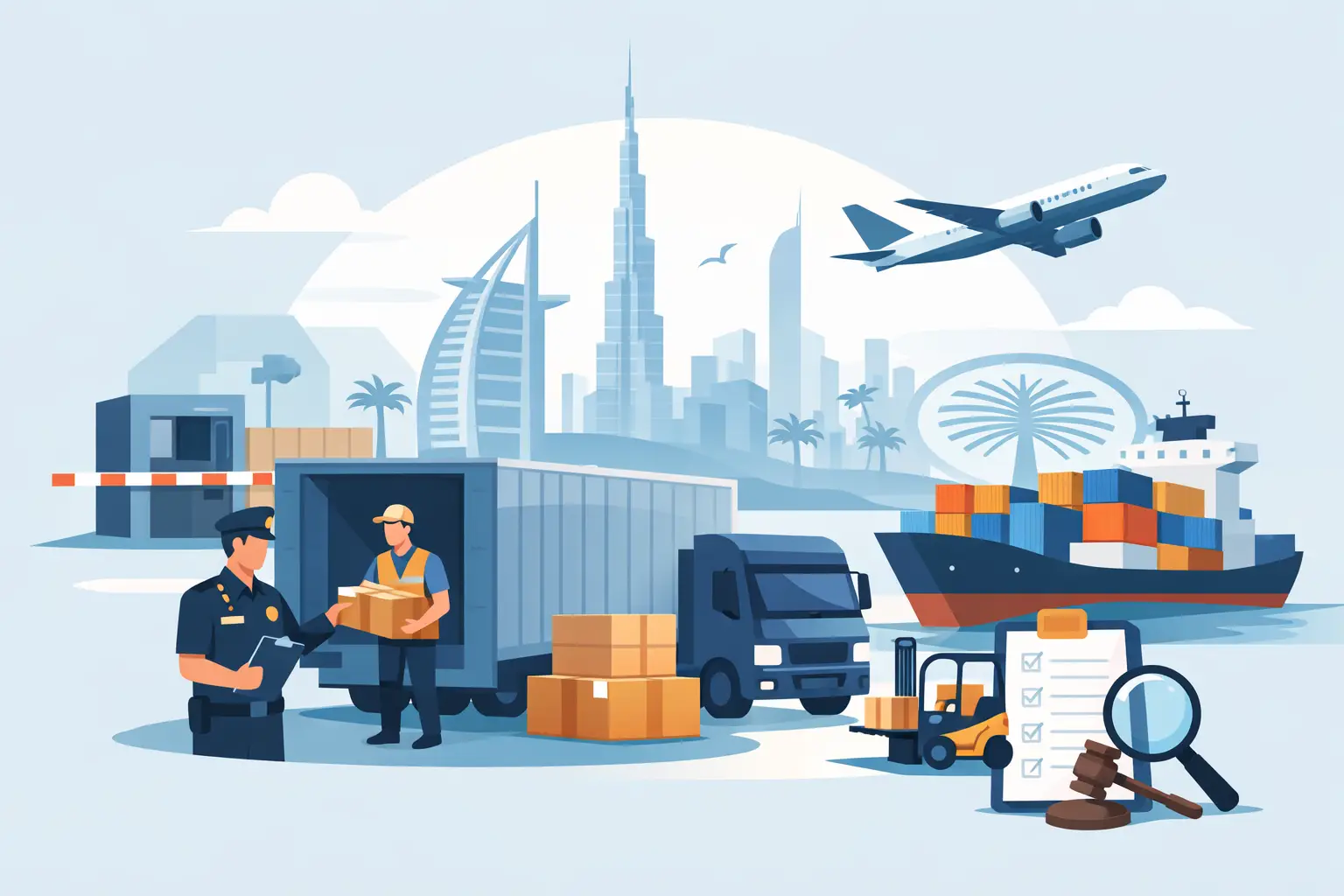
A shipment can reach Dubai on schedule and still lose valuable time at the border if the paperwork, cargo details, or consignee registration do not match. UAE customs procedures are not simply an administrative final step. For commercial importers and exporters, they shape the cost, release timeline, and onward delivery plan for every air, sea, road, and consolidated shipment.
The practical objective is clear: make the customs declaration accurately reflect the goods that physically arrive. That means preparing documents before cargo dispatch, using a defensible commodity description and tariff classification, and understanding whether the shipment is entering the UAE mainland, moving into a free zone, or transiting onward to another country.
How UAE Customs Procedures Work for Cargo
Customs processing starts well before an aircraft lands or a container is discharged. The importer, exporter, consignee, freight forwarder, carrier, and customs broker each contribute information that must remain consistent across the commercial invoice, packing list, transport document, and customs declaration.
For inbound commercial cargo, the normal process involves registering the shipment with the relevant customs authority, submitting the declaration and supporting documents, calculating applicable charges where required, and waiting for release or further inspection instructions. In Dubai, electronic declaration processes may involve Mirsal compliance requirements. Procedures can differ by emirate, shipment type, and cargo location, so the correct process depends on where the goods arrive and where they will be cleared.
Customs may release a shipment based on the submitted information or request additional documents, valuation support, clarification of the goods, or a physical examination. A request for inspection does not necessarily indicate a problem. It does, however, require coordinated handling between the consignee, cargo terminal, warehouse operator, and customs representative.
For exporters, customs formalities confirm that goods are leaving the country under the appropriate declaration. Export documents also matter at destination. A vague product description accepted at origin can create an issue when cargo reaches Iraq, Saudi Arabia, Syria, or another receiving market with its own import rules.
Documents That Support Full Customs Clearance
The required document set varies by commodity, trade lane, and customs regime, but commercial shipments generally need a clear and consistent core file. Preparing it early is one of the most effective ways to avoid preventable delays.
For most commercial cargo, the file should include:
- A commercial invoice showing the seller, buyer, currency, transaction value, Incoterms, country of origin, and a specific description of the goods.
- A packing list that matches the actual packages, quantities, weights, dimensions, and marks.
- The transport document, such as an air waybill, bill of lading, or road transport document.
- The importer or consignee details required for customs registration and clearance.
- Any product-specific approvals, certificates, permits, or origin documents requested for the commodity or destination market.
Descriptions deserve particular attention. âGeneral merchandise,â âspare parts,â or âsamplesâ may not provide enough information for classification or inspection. A useful description identifies what the item is, what it is made from where relevant, its intended commercial use, and the model or part number when available. The invoice, packing list, and transport document should tell the same story.
The declared value must also be commercially supportable. Customs authorities can review valuation information, especially where the invoice is incomplete, goods are unusually low-priced, or freight and insurance details affect the customs value. Keeping purchase orders, payment records, and supplier correspondence organized can help when additional confirmation is requested.
Mainland, Free Zone, and Transit Cargo Are Different
A common source of confusion is treating every arrival in Dubai as a standard mainland import. The clearance path changes according to the cargoâs intended use and destination.
Cargo entering the UAE mainland is generally processed for local entry and distribution. The importer must have the appropriate commercial setup and customs registration for the transaction. Applicable customs duties, VAT, and other charges depend on the goods, origin, value, and current rules. They should be verified for each shipment rather than assumed from a previous import.
Cargo moving to a free zone follows a different operational path. Free-zone movements can support storage, consolidation, re-export, and regional distribution, but goods are not automatically treated as mainland-cleared simply because they are physically in the UAE. If cargo later moves from a free zone into the mainland, further customs processing may be required.
Transit and re-export shipments require careful control as well. A shipment arriving from China or Hong Kong for onward movement to Iraq, Saudi Arabia, or another regional destination needs documents that support both UAE handling and destination import requirements. The routing choice matters: air freight may suit urgent, higher-value replenishment cargo, while FCL, LCL, or road freight may be more practical for larger volumes and planned distribution.
Classification, Origin, and Value: The Details That Matter
Customs declarations rely on three commercial facts: what the goods are, where they originate, and what they are worth. These details influence the tariff treatment, documentary requirements, and the likelihood of questions during clearance.
Commodity classification should be based on the actual product, not the broad product category used in a supplierâs sales invoice. For example, a shipment of electrical components may include different parts with different classifications. Combining distinct products under one generic line can make declaration and inspection more difficult.
Country of origin is also not always the same as the country of shipment. Goods shipped from a supplier in one country may have been manufactured elsewhere. Ensure the origin stated on invoices and certificates, when required, is accurate and consistent with the product records.
Incoterms should be shown clearly because they establish which costs and responsibilities are included in the transaction. They do not replace customs requirements, but they help clarify the relationship between the goods value, freight, insurance, and declared shipment value. For traders buying on EXW, FOB, CIF, or DDP terms, the operational responsibilities differ substantially. A forwarder should review the handoff points before cargo is collected, not after it has arrived.
Preventing Delays Before the Shipment Moves
The best time to address customs risk is at booking. Ask the supplier for draft documents before cargo collection or container loading. Compare the documents against the purchase order and the physical cargo plan. If there are multiple product types, confirm whether they will be packed, labeled, and invoiced in a way that supports line-by-line declaration.
Packaging and markings also affect customs handling. Carton numbers, pallet counts, and gross and net weights should match the packing list. If customs selects cargo for examination, a well-organized shipment is faster to verify than mixed cartons with unclear labels. For LCL and consolidated cargo, accurate package identification is particularly important because several importersâ goods may be handled within the same consolidation.
Build time into the supply plan for possible document review, terminal handling, inspection, or amendments. Clearance timing depends on the accuracy of the declaration, cargo type, authority workload, release instructions, and supporting approvals. No responsible logistics provider should promise release at a fixed time when those variables remain outside its control.
Working With a Freight Forwarder on Customs Handling
A capable Dubai freight forwarder coordinates the points where customs issues often appear: origin collection, document review, carrier handover, declaration preparation, cargo release, and final delivery. This is especially useful for businesses managing repeat imports, multi-supplier consolidation, or deliveries that continue across the GCC and Middle East.
Anker Shipping Services can arrange end-to-end freight movements with customs clearance support, documentation coordination, and dedicated operational communication. For a China-to-Dubai consolidation, a Dubai-to-Saudi road movement, or air cargo requiring quick onward delivery after release, the aim is to keep every handoff visible and every document aligned with the shipment plan.
A forwarder cannot change a customs authorityâs decision or substitute for an importerâs regulatory responsibilities. What experienced operations support can do is identify gaps early, request clearer supplier documents, coordinate inspections when instructed, and keep the consignee informed of the next action required.
A Better Starting Point for Every Shipment
Before confirming your next booking, review the commodity description, origin, declared value, consignee registration, and destination route as one connected file. When the cargo, documents, and customs declaration match from the start, UAE customs procedures become a manageable part of trade operations rather than an unexpected interruption to delivery.