
A delayed production part, a seasonal retail launch, and a full container of regular stock should not be shipped the same way. The decision between sea freight versus airfreight affects more than the freight invoice. It influences inventory availability, packaging requirements, customs preparation, delivery planning, and the level of risk your business carries if a shipment is delayed.
For commercial cargo moving through Dubai and into markets across the GCC, Iraq, Syria, Asia, Europe, or Africa, the best option is rarely just the fastest or cheapest mode. It is the mode that supports the shipment's commercial purpose while meeting documentation, handling, and delivery requirements.
Sea Freight Versus Airfreight: The Core Difference
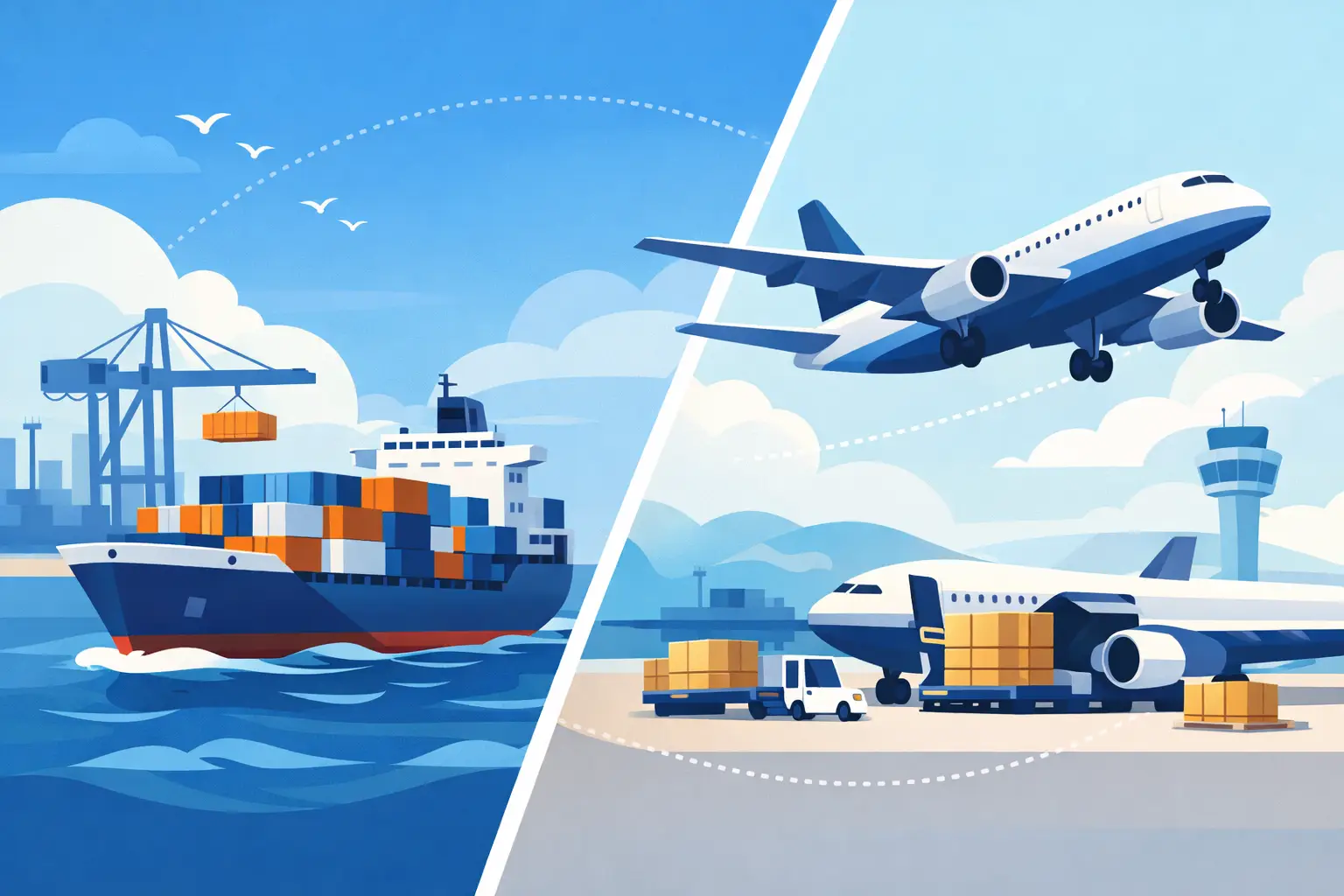
Sea freight moves cargo in containers or consolidated shipments by ocean vessel. It is generally suited to larger volumes, heavier goods, planned replenishment, and cargo where a longer transport cycle is commercially acceptable. Shippers can use full container load (FCL) when they need dedicated container space, or less than container load (LCL) when their cargo shares a container with other shipments.
Airfreight moves cargo through airline networks and is usually selected for urgent, high-value, lightweight, or time-sensitive commercial shipments. It can be particularly useful when a buyer needs to avoid a stockout, replace a damaged component, support a product launch, or move samples and smaller consignments quickly.
The practical distinction is capacity versus speed. Sea freight usually gives a business more economical access to volume. Airfreight reduces transport time but often increases the cost per chargeable kilogram. Neither is automatically better. The right answer depends on the cargo and the commercial deadline behind it.
Start With the Cost of Delay, Not Only the Freight Cost
Comparing shipping modes only by the quoted freight charge can lead to an expensive decision. A lower sea freight cost may not help if delayed inventory stops a distributor from fulfilling orders, holds up a factory, or causes a retailer to miss a seasonal sales period. Conversely, using airfreight for routine, bulky replenishment can consume margin that could have been protected through earlier procurement planning.
Airfreight charges are commonly based on actual weight or volumetric weight, whichever is higher. This makes the dimensions of cartons, pallets, and crates especially important. A lightweight but oversized shipment can be costly by air because it occupies significant aircraft space.
Sea freight pricing is usually better aligned with shipment volume, container requirements, port handling, and the origin-destination route. FCL may offer greater control for regular, high-volume movements, while LCL can be useful for smaller commercial consignments that do not justify a full container. However, LCL cargo needs careful planning because consolidation, deconsolidation, and handling at each end are part of the movement.
A sound comparison includes freight, origin handling, destination charges, customs-related requirements, insurance needs, local delivery, and the internal cost of keeping extra inventory. The lowest quoted transport price is not always the lowest landed cost.
When airfreight can be commercially sensible
Airfreight is often justified when goods are urgently needed and the cost of waiting exceeds the additional transport spend. This can include critical spare parts, electronics, medical or industrial equipment permitted for carriage, high-value accessories, product samples, or urgent replenishment for established customers.
It may also work well as a targeted solution. Instead of flying an entire purchase order, a business can airfreight the first portion needed for immediate sales or production and send the balance by sea. This approach helps protect continuity without making every shipment an airfreight shipment.
When sea freight is the stronger choice
Sea freight generally suits palletized goods, machinery, building materials, commercial stock, consumer products, and other cargo with predictable demand. It is especially relevant for importers bringing regular inventory from China or Hong Kong to Dubai, as well as exporters moving larger cargo volumes through regional and international ports.
For businesses with reliable sales forecasts, sea freight supports planned replenishment at a cost structure that can be easier to absorb across a larger volume of goods. The key is to place orders early enough to account for the full cycle from supplier readiness through port procedures, customs clearance, and final delivery.
Cargo Size, Density, and Packaging Change the Equation
The same product can be suitable for airfreight or sea freight depending on how it is packed. Carton dimensions, pallet height, stackability, fragility, and total shipment volume all influence the available options.
Air cargo must meet airline acceptance and security requirements. Packaging should protect the goods while avoiding unnecessary volume. Clear shipment markings, accurate packing lists, and properly declared weights reduce the risk of operational delays at handover.
Sea cargo faces a different handling environment. Goods may be loaded, moved through terminals, consolidated with other cargo, and transported over a longer period. Export packaging should be strong enough for handling and, where appropriate, protect cargo from moisture and movement. For FCL shipments, correct container loading, lashing, weight distribution, and cargo securing are essential. For LCL, packaging must account for shared-container handling.
Project cargo and oversized equipment require an even earlier review. Dimensions, lifting points, packing method, and route feasibility can determine whether a shipment needs specialized sea arrangements, air cargo assessment, road transport coordination, or a multimodal plan.
Customs Documents Must Match the Physical Shipment
Mode selection does not remove the need for accurate customs documentation. Whether cargo travels by air or sea, the invoice, packing list, product description, quantities, weights, country of origin information, and other applicable documents must be consistent with the actual shipment.
Small discrepancies can create avoidable questions during customs processing or at destination handoff. An unclear product description, a missing document, or a mismatch between declared and physical quantities can affect the shipment schedule regardless of how quickly it traveled.
For cargo moving through the UAE, businesses should prepare documentation early and ensure the shipment data supports applicable customs procedures and Mirsal requirements. Destination-country requirements also need to be reviewed before cargo is dispatched, particularly on regional routes where import processes, consignee details, and supporting documents may differ.
An experienced freight forwarder can coordinate document checks, cargo collection, consolidation where needed, customs clearance support, and destination delivery planning. At Anker Shipping, this means arranging the operational handoffs as one managed movement rather than leaving the shipper to coordinate separate providers.
Route Conditions Can Affect the Better Mode
The origin and destination matter as much as the cargo. A China-to-Dubai replenishment shipment may have dependable sea freight planning potential when purchase orders are scheduled well in advance. A Dubai-to-Saudi Arabia shipment may require a closer comparison of air, sea, and road options based on cargo type, destination, and urgency.
For Iraq and Syria routes, practical planning is particularly important. The consignee's readiness, document accuracy, handover arrangements, and destination delivery requirements should be confirmed before booking. A faster flight does not solve a destination-side issue, just as an economical sea movement does not help if inventory was ordered too late.
Businesses should also consider whether the shipment needs door-to-door service. Port-to-port or airport-to-airport freight may look simple on paper, but the cargo still needs collection, export processing, destination clearance coordination, and delivery to the final site. End-to-end management makes responsibilities clearer across each handoff.
Use a Split-Mode Plan for Better Inventory Control
Sea freight versus airfreight does not always have to be an either-or decision. Many importers use a split-mode strategy to balance cash flow and service levels. Core inventory moves by sea under a regular replenishment plan, while a smaller urgent quantity moves by air when demand exceeds forecast or a supplier release is delayed.
This approach works best when purchase orders are divided clearly at origin and the documentation for each shipment is prepared separately. The air portion should contain the products that genuinely protect sales, production, or customer commitments. The sea portion can carry the remaining volume at a more practical cost per unit.
Over time, shipment data can reveal whether airfreight is being used for real exceptions or for a planning gap that should be addressed through earlier ordering, better stock forecasting, or more appropriate safety-stock levels.
Make the Decision Before the Cargo Is Ready
The best freight decisions are made at purchase-order stage, not when cartons are already waiting at a supplier's factory. At that point, a logistics partner can assess weight and dimensions, packing needs, origin collection, consolidation opportunities, customs documentation, destination requirements, and final delivery expectations.
If your cargo is urgent, compact, and commercially valuable, airfreight may protect the outcome. If it is heavy, high-volume, and supported by a reliable forecast, sea freight may provide the better foundation for margin control. The practical next step is to share the cargo details and delivery objective early, so the shipping plan supports the business before the deadline starts driving the decision.