
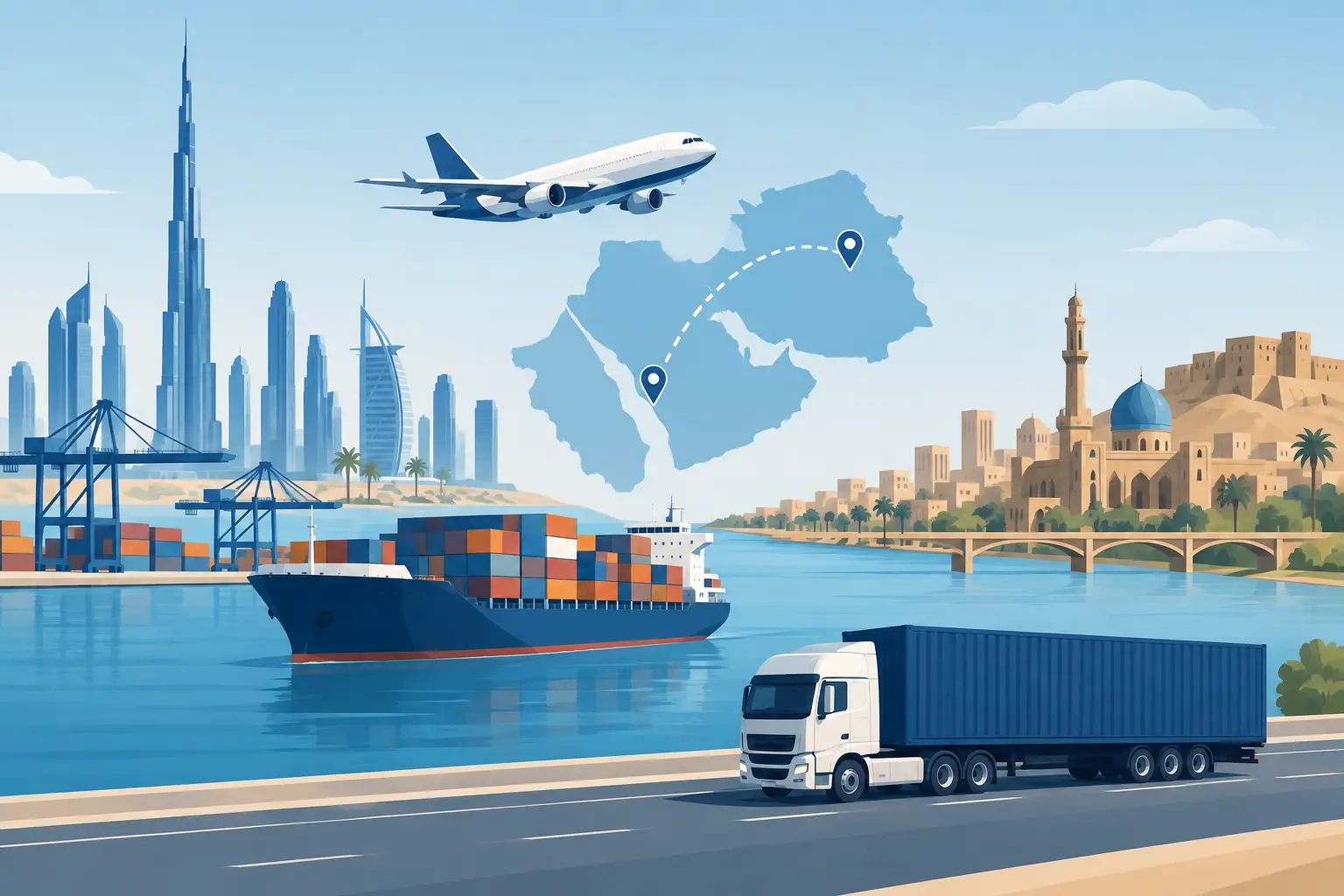
A Dubai to Iraq logistics guide is most useful when it starts with the operational questions that determine whether cargo moves without avoidable delays: Where in Iraq is the final delivery point? Is the shipment urgent, heavy, containerized, or part of recurring stock replenishment? And are the shipping documents aligned with the goods, buyer, and consignee requirements?
For commercial shipments, Dubai is a practical consolidation and export hub. Cargo may arrive from suppliers in Asia, Europe, or elsewhere, then move onward to Iraq by air, sea, or road. The right plan depends less on finding a single âbestâ mode and more on matching the transport method, paperwork, packaging, and destination handling to the shipment.
Dubai to Iraq Logistics Guide: Start With the Route
Iraq is not a one-route market. Delivery planning should account for the destination city, the consignee's import arrangements, cargo type, and the required speed of delivery. A shipment going to a major commercial center may follow a different handling sequence from cargo destined for a regional project site or distribution point.
Before booking freight, confirm the cargo's final destination rather than using Iraq as the only destination reference. This affects the available carrier options, onward transport requirements, terminal handling, and the information required for customs clearance. It also helps avoid a common issue: freight being quoted only to an airport or port when the buyer expects door-to-door delivery.
A capable freight forwarder coordinates the handoffs from UAE collection or supplier receipt through export formalities, main carriage, destination clearance support, and final delivery arrangements. For businesses managing repeat orders, that coordination can be more valuable than choosing a route based only on the initial freight charge.
Choose the Freight Mode Around the Cargo
Air freight for urgent or higher-value shipments
Air freight is often appropriate for time-sensitive commercial cargo, samples, spare parts, electronics, and smaller consignments where speed and handling control matter more than freight cost per kilogram. It can also support replenishment shipments when a customer needs stock sooner than a sea freight schedule can provide.
The trade-off is cost. Airfreight charges are generally influenced by actual or volumetric weight, so large but lightweight cartons can be more expensive than expected. Accurate carton dimensions, total weight, commodity description, and packing details should be supplied before the shipment is booked.
Sea freight for planned volume
Sea freight is generally suited to palletized cargo, larger commercial lots, and shipments where planning flexibility allows for port handling and onward movement. Full container load, or FCL, gives one shipper use of a container. Less than container load, or LCL, combines cargo from multiple shippers in a consolidated shipment.
FCL can offer better cargo control for regular, higher-volume movements. LCL can be a more practical choice for smaller shipments that do not justify a full container. However, LCL involves consolidation and deconsolidation handling, so packing, labeling, and document accuracy become especially important.
Sea freight is not automatically the lowest total-cost option. A comparison should include origin collection, export clearance, port charges, destination handling, customs processing, and inland delivery. A low ocean freight figure can create a misleading picture if the rest of the movement has not been planned.
Road freight for regional movement and final delivery
Road freight can support cross-border cargo movements and inland delivery from a regional gateway to the final consignee. It is often used where trucking provides a practical balance between delivery reach, cargo volume, and operational requirements.
Road routing requires close attention to documentation consistency, truck loading plans, packaging strength, and border procedures. Transit conditions can vary with border operations, inspections, carrier capacity, and destination readiness. For that reason, businesses should build flexibility into purchase orders and inventory plans rather than relying on a fixed delivery day.
Prepare Documents Before Cargo Is Collected
Documentation should be prepared as part of shipment planning, not after the cargo reaches the airport, port, or border. The commercial invoice, packing list, transport document, and consignee information need to describe the shipment consistently. Differences in quantities, product descriptions, values, or party names can create questions that delay processing.
For Dubai exports to Iraq, the required paperwork may vary according to the cargo, buyer, destination, and import process. Your logistics provider can guide the operational document set and coordinate with the shipper and consignee, but the commercial parties remain responsible for providing correct source information.
A practical pre-shipment file should include:
- Commercial invoice with clear product descriptions, quantities, currency, and agreed Incoterms
- Packing list showing carton, pallet, or package counts, weights, and dimensions
- Shipper and consignee details that match the sales and import records
- Any product-specific paperwork requested by the consignee or destination authorities
- Cargo insurance instructions, where cover is required for the shipment
Clear descriptions matter. Generic terms such as âparts,â âequipment,â or âgoodsâ may not provide enough operational detail for freight handling or customs review. Describe what the product is, what it is made of when relevant, and how it is packed. The description should still match the invoice and supporting sales documents.
Build Cargo Readiness Into the Plan
Cargo preparation affects both cost and risk. Cartons should be strong enough for the chosen mode, especially when freight will be consolidated, palletized, or transferred between vehicles. Pallets should be stable, securely wrapped, and labeled on visible sides. Each handling unit should be identifiable against the packing list.
Measure and weigh the finished shipment after packing, not before. Freight capacity and charges are based on the cargo as tendered, including pallets, crates, and protective materials. This is particularly relevant for air freight, where volumetric calculations may apply, and for LCL shipments, where volume is a central rating factor.
For machinery, commercial equipment, or project cargo, share photographs, dimensions, center-of-gravity information where applicable, and loading constraints early. Specialized cargo is easier to plan when the forwarder understands how it can be lifted, secured, and delivered before pickup is arranged.
Clarify Who Controls Each Handoff
Many shipping problems are not caused by a lack of transport capacity. They occur because no one has confirmed who is handling an export declaration, who receives the cargo at destination, who provides clearance documents, or whether the consignee is ready to accept delivery.
A door-to-door shipment should have a defined handoff plan from the outset. That includes collection location, export customs processing, main freight, destination arrival procedures, clearance coordination, payment responsibilities, delivery address, receiving hours, and proof of delivery expectations.
Incoterms should be agreed in the sale contract before freight is arranged. They influence which party is responsible for freight, insurance, import clearance, duties and taxes, and delivery. They do not replace a detailed shipping instruction. The shipper and buyer should still agree on the named place, contact details, cargo readiness date, and document process.
Use Visibility to Manage Exceptions
Shipment visibility is most valuable when it helps a business act early. Tracking updates should be paired with operational communication: cargo collected, export cleared, departed, arrived, documents received, clearance in progress, and delivery scheduled. If an issue arises, the relevant party needs enough notice to provide a document, confirm an address, or arrange payment without holding up the cargo.
For repeat Dubai-to-Iraq movements, establish a standard shipping profile. Record preferred collection locations, usual commodity descriptions, packing formats, consignee contacts, document templates, and delivery instructions. This reduces repetitive clarification and gives the logistics team a more reliable basis for arranging each shipment.
Anker Shipping Services FZCO can coordinate air, sea, and road freight from Dubai with customs documentation support, consolidation options, and dedicated shipment management. The goal is not to force every shipment into the same service, but to arrange the mode and handoffs that fit the commercial requirement.
The most practical next step is to prepare a complete shipment brief before requesting a quote: origin, final Iraqi destination, cargo description, package dimensions and weight, ready date, invoice value, required delivery terms, and consignee contact. Better information at the start creates a clearer routing decision and a more controlled shipment from collection to delivery.