
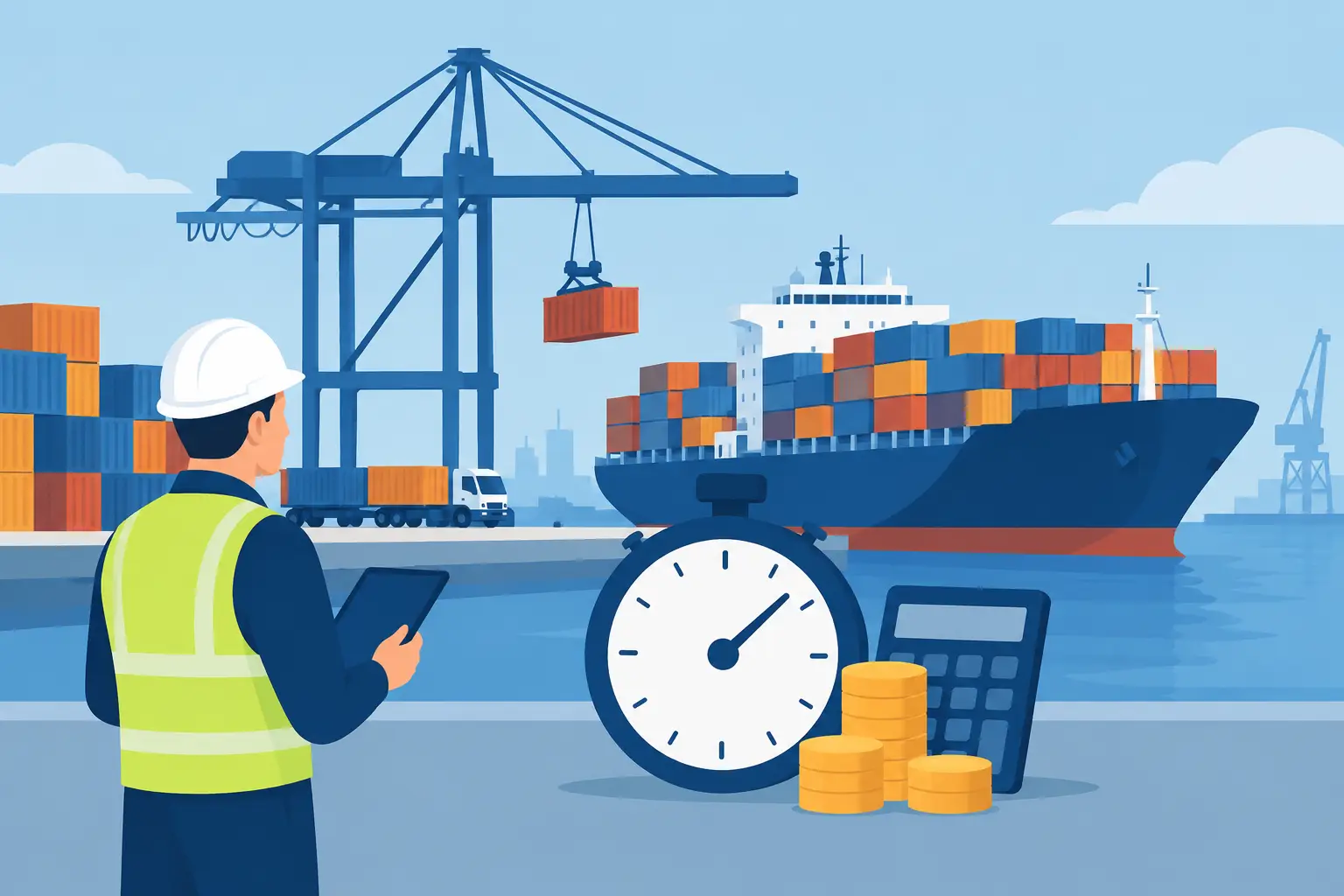
A container can arrive on schedule and still become an expensive shipment. Cargo demurrage begins when an import container remains at the port or terminal beyond its allowed free time, creating charges that can grow each day until the cargo is cleared and collected. For importers moving FCL, LCL, or consolidated shipments through Dubai and other regional gateways, controlling these costs depends less on last-minute transport and more on release planning before the vessel arrives.
Demurrage is often treated as a port problem. In practice, it is usually a handoff problem. A missing document, an unapproved payment, a customs query, a delayed delivery order, or an unavailable truck can keep a container in place long after the cargo itself is ready to move. The most effective response is to manage each of those handoffs as one operational plan.
What cargo demurrage means in practice
Cargo demurrage is a charge applied by the shipping line when a laden container stays within the port, terminal, or designated container area beyond the free days stated in the applicable shipment terms. Free time is not universal. It can vary by carrier, trade lane, equipment type, contract arrangement, and whether the shipment is import, export, FCL, or LCL.
The clock generally matters from the point the container becomes available under the carrier and terminal process, but the specific trigger and calculation must be checked against the relevant shipping documents and carrier notice. Importers should not assume that a vessel arrival date, a customs filing date, and the start of free time are the same event.
For a business receiving commercial goods, demurrage is particularly disruptive because it is usually only one part of the cost exposure. Terminal storage may also apply. If the container is later removed from the terminal but is not returned to the carrier's nominated depot within the allowed period, detention charges may follow. These are related charges, but they are not interchangeable.
Demurrage, detention, and storage are different
Demurrage concerns the loaded container while it remains under port or terminal control beyond free time. Detention generally concerns the carrier's container after it has been collected and is outside the terminal. Storage is a terminal or port charge for cargo or equipment remaining in its facility beyond the permitted period.
A shipment can incur more than one of these charges if its release and delivery sequence is not managed carefully. For example, a customs delay may result in terminal storage and demurrage. A later delay in unloading at the consignee's premises or returning the empty container can create detention. Reviewing each charge category early helps finance and logistics teams identify where the real delay occurred.
Why demurrage happens even on routine shipments
The most common cause is not an unusual customs issue. It is a lack of readiness. Cargo reaches the destination while documents, authority to clear, delivery planning, and payment approvals are still moving through separate teams.
For imports into the UAE, customs documentation should be reviewed before arrival wherever possible. Commercial invoices, packing lists, transport documents, commodity descriptions, values, and consignee details need to align. Inconsistent descriptions or missing supporting information can lead to questions that consume valuable free time. Customs requirements can differ according to the cargo, origin, destination, and import structure, so the shipment should be assessed on its own facts rather than copied from a previous transaction.
Original document requirements can also affect release. Where originals are needed, the consignee should know who holds them, how they will be transferred, and what release process applies. When electronic or telex release is used, the status still needs to be verified before collection is scheduled.
Another frequent issue is booking delivery transport too late. A container may be customs-cleared but remain at the terminal because the delivery address is not ready, the receiver has not confirmed offloading arrangements, or suitable equipment has not been arranged. This is especially relevant for heavy cargo, oversized pieces, project cargo, or deliveries with restricted receiving hours.
Build the release plan before vessel arrival
The practical way to reduce cargo demurrage exposure is to work backward from the expected arrival notice. The objective is not simply to clear cargo quickly. It is to ensure that every party can act when the container becomes available.
Start by confirming the shipment reference, carrier details, consignee information, cargo description, container quantity, and expected arrival window. Then review the free-time terms in writing. Do not rely on a general assumption based on a prior shipment, because carriers and equipment arrangements may differ.
Next, place the document pack under one owner. This may be the importer, an internal logistics coordinator, or a freight forwarder handling end-to-end management. What matters is that one party confirms whether the commercial invoice, packing list, bill of lading or sea waybill, import permits where applicable, customs data, and any product-specific documents are complete and consistent.
Payment readiness should be addressed at the same stage. Customs duty, taxes, terminal-related charges, carrier release costs, and delivery expenses may require approval before cargo can move. A delay caused by an unapproved payment can be just as costly as a documentation issue.
Finally, make the physical delivery plan specific. Confirm the delivery location, contact person, receiving hours, access restrictions, unloading equipment, and whether the container can be unloaded promptly. If the shipment requires cross-docking, warehousing, distribution, or delivery to another GCC destination, those arrangements should be coordinated before release rather than after the container is already accruing charges.
A better process for FCL and LCL cargo
FCL and LCL shipments require different planning because the release path is different. With FCL cargo, the importer is managing a full container and must coordinate customs clearance, collection, delivery, unloading, and empty return. The container itself is part of the time-sensitive operation.
With LCL or groupage cargo, the shipment is consolidated with cargo from other shippers. The deconsolidation process, terminal handling, release instructions, and warehouse collection arrangements may affect when the goods can be collected. Businesses should confirm which party is responsible for destination handling and what documents are needed for release from the consolidator or nominated facility.
The key trade-off is that LCL can be commercially sensible for smaller volumes, but it may involve additional handling points. FCL gives greater control over the container movement, but it requires the consignee to manage equipment return and delivery timing carefully. The right choice depends on cargo volume, urgency, destination handling capability, and the total landed-cost picture, not only the ocean freight rate.
Use a clear exception process
Even well-prepared shipments can encounter vessel schedule changes, port congestion, inspection requirements, or receiver delays. The difference between a manageable disruption and escalating charges is the speed of escalation.
Set a practical exception process for every import. If a document is missing, identify the responsible party and a deadline for correction. If customs requests clarification, make sure the commercial team can provide accurate product information quickly. If delivery cannot proceed, assess whether alternative receiving arrangements, temporary storage, or a revised transport plan are possible before free time expires.
Keep a written timeline of arrival notice, document receipt, customs submission, approval status, carrier release, terminal availability, truck booking, gate-out, delivery, and empty return. This record helps identify bottlenecks and supports constructive discussions when a charge needs to be reviewed. It also creates better discipline for future shipments.
Where an experienced forwarder adds value
A freight forwarder cannot remove every carrier or terminal charge, and no responsible provider should promise clearance or release outcomes that depend on third parties. What an experienced forwarder can do is coordinate the shipment as one chain rather than a set of disconnected tasks.
For commercial shipments moving through Dubai, Anker Shipping can arrange freight, customs clearance support, documentation coordination, delivery planning, and follow-up across the relevant handoffs. This is particularly useful for traders managing cargo from China or Hong Kong into Dubai, or onward movements across GCC and Middle East markets, where the importer may be coordinating suppliers, carriers, buyers, and destination receivers at the same time.
Dedicated support matters most before the cargo arrives. A forwarder that has the complete shipment file can flag document gaps, confirm release steps, coordinate transport availability, and keep the consignee informed of actions that affect the free-time window. Full regulatory compliance remains the importerâs responsibility, but experienced operational support helps ensure requirements are addressed early rather than under pressure at the terminal.
Make demurrage a planning metric, not an emergency cost
Businesses that import regularly should review demurrage exposure alongside freight cost, customs processing time, and delivery performance. Look for repeat patterns: the same supplier submitting incomplete paperwork, the same internal payment delay, the same receiver unable to unload containers on time, or the same trade lane requiring more lead time for document review.
The goal is not to eliminate every exception. Shipping involves variables outside any one partyâs control. The goal is to create enough visibility and decision time that exceptions do not automatically turn into daily charges. When cargo, documents, customs processing, and final delivery are planned as one movement, the container spends less time waiting and the business keeps better control of its landed cost.