
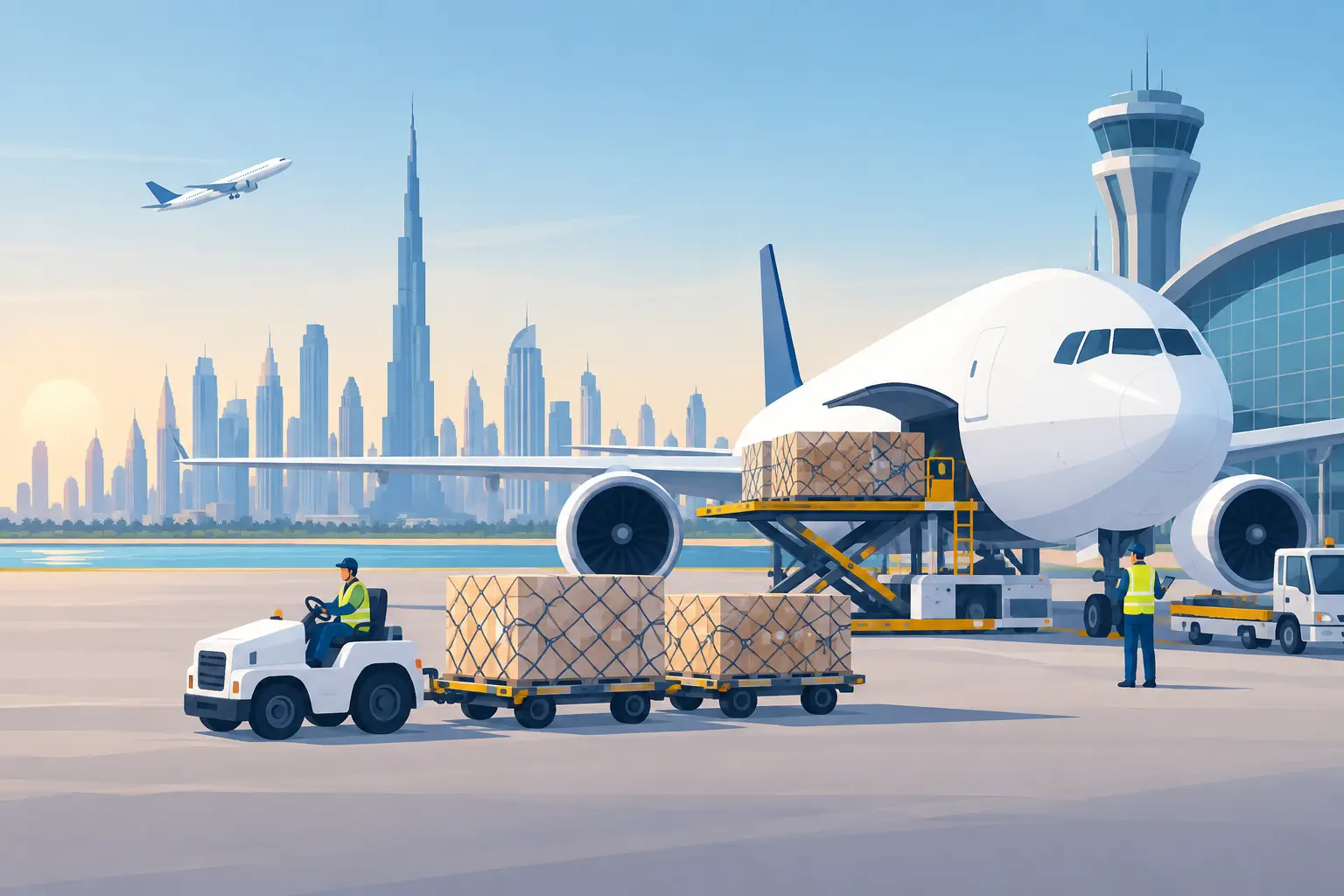
A shipment arriving through Dubai Airport can lose valuable time long before it reaches the cargo terminal. Incomplete invoices, mismatched product descriptions, poor carton labeling, and unclear delivery instructions can all delay release and onward movement. Choosing the best Dubai airport logistics services is therefore less about finding the lowest headline freight charge and more about selecting a forwarder that can control each handoff, from booking and document review to customs clearance and final delivery.
For importers, exporters, traders, and distributors, Dubai is a practical air cargo gateway for urgent replenishment, high-value commercial goods, samples, consolidated cargo, and shipments connecting the UAE with Iraq, Syria, Saudi Arabia, China, Hong Kong, and wider international markets. The right logistics arrangement depends on the cargo, the route, the urgency, and the responsibilities at origin and destination.
What the Best Dubai Airport Logistics Services Should Cover
Airport freight is not a single service. It is a chain of coordinated actions involving the shipper, airline or consolidator, ground handling, customs authorities, warehouse teams, transport providers, and consignee. If one party is working from different shipment details, the disruption affects everyone downstream.
A capable Dubai freight forwarder should arrange everything needed for the agreed scope: cargo collection or supplier coordination, air freight booking, export and import documentation support, customs processing, cargo handling, delivery planning, and shipment updates. This end-to-end management gives commercial buyers a single accountable point of contact rather than requiring them to chase several vendors.
The most suitable service provider will also explain what is included and what requires separate approval. For example, a quote may cover airport-to-airport freight but not destination clearance, storage that results from delayed documents, inspections, duties, or delivery to a remote destination. Transparent scope is essential for predictable freight planning.
Air Freight Is Best When Speed Has Commercial Value
Air freight is often the right choice when stockouts could interrupt sales, when a project requires a specific component, or when goods have a high value relative to their size. It can also be useful for time-sensitive commercial samples, product launches, and smaller consignments that do not justify a full sea container.
That does not mean every shipment should fly. Large, dense, or less urgent cargo may be more economical by sea freight, particularly on regular purchasing cycles. Many businesses use a mixed approach: urgent inventory moves by air while core stock replenishment moves by FCL, LCL, or consolidated sea freight. A logistics partner should help compare these options based on cargo volume, chargeable weight, readiness date, destination requirements, and delivery deadline.
Start With the Cargo, Not the Freight Quote
An accurate freight plan begins with complete cargo information. Air freight charges are generally based on the higher of actual weight or volumetric weight, so carton dimensions matter as much as the scale weight. A shipment described simply as âgeneral cargoâ is rarely enough for a reliable booking or clearance plan.
Before requesting a quote, prepare the commercial details your forwarder will need: the collection location, destination city, number of packages, dimensions, gross weight, commodity description, declared commercial value, and preferred service level. Include the Incoterm agreed with the supplier or buyer, since it defines where cost and responsibility transfer.
For commercial goods, the product description should be specific and consistent across the invoice, packing list, and transport documents. âElectronic accessories,â for example, may be too broad if the cartons contain several distinct items. Clear descriptions support correct documentation review and reduce questions during customs procedures.
Cargo preparation also matters. Cartons should be suitable for airport handling and transport, with clear marks that match the packing list. Where appropriate, separate cartons by product type and use durable outer packaging. If the shipment includes fragile, oversized, temperature-sensitive, or project cargo, disclose that at the planning stage so handling and routing can be arranged appropriately.
Documentation Is the Center of Airport Cargo Control
Commercial cargo cannot move efficiently on verbal instructions alone. The paperwork tells carriers, customs teams, and destination agents what is moving, who is responsible, and how the shipment should be processed.
A standard air freight movement commonly requires a commercial invoice, packing list, airway bill information, and supporting documents relevant to the commodity or trade arrangement. Depending on the shipment and destination, additional paperwork may be needed. Requirements can change, so businesses should confirm the document set for each shipment rather than relying on forms used for a previous order.
Document consistency is particularly important. The shipper name, consignee details, quantities, weights, values, country of origin information, and product descriptions should align across the paperwork. Even small differences can trigger clarification requests and affect the timing of release.
For imports into Dubai, customs declarations and supporting documents need to be prepared accurately through the relevant processes. For exports, the destination countryâs import requirements should be considered before cargo is handed over. An experienced forwarder can provide practical documentation support and coordinate the operational requirements, but importers and exporters remain responsible for providing truthful and complete commercial information.
Choosing Between Direct, Consolidated, and Door-to-Door Service
Not every air cargo shipment needs the same routing model. Direct services may suit urgent freight where minimizing handoffs is the priority. Consolidated air cargo can be a practical option for smaller commercial shipments when schedule flexibility is available and cost control matters.
Door-to-door service reduces the number of tasks handled internally by the shipper. It can include collection from the supplier, airport freight arrangements, full customs clearance within the agreed scope, and final delivery. This is especially useful for businesses buying from China or Hong Kong for delivery into Dubai, or for UAE exporters coordinating commercial deliveries into regional markets.
Airport-to-airport service may be appropriate for experienced importers and exporters that already have a reliable clearance and delivery arrangement at destination. The trade-off is greater control over local suppliers, but also more coordination responsibility. The best choice depends on whether your team has the capacity to manage destination formalities, cargo release, and last-mile transport.
A Practical Checklist for Selecting a Dubai Airport Forwarder
When comparing providers, assess operational fit rather than relying only on a freight figure. The following questions help identify whether the service is designed for commercial cargo movement:
- Can the forwarder handle air freight, customs clearance, delivery, and document coordination under one shipment plan?
- Does the team understand your origin and destination route, particularly for GCC, Iraq, Syria, China, or Hong Kong trade flows?
- Will you receive a clear breakdown of the freight scope, exclusions, and information required before booking?
- Can the provider arrange consolidation, express handling, general cargo, or specialized project cargo when needed?
- Is there dedicated support for updates, exceptions, document corrections, and delivery coordination?
A forwarder that asks detailed questions early is usually protecting the shipment, not creating unnecessary complexity. Cargo dimensions, commodity details, supplier readiness, consignee contacts, and destination delivery conditions all influence the final plan.
Route Knowledge Matters After the Aircraft Lands
Airport logistics does not end with flight departure or arrival. For UAE imports, cargo may require clearance, release coordination, and delivery into Dubai, Dubai South, Jebel Ali Free Zone, Sharjah, Abu Dhabi, or another UAE location. For exports, the shipment may need onward coordination with the consigneeâs broker, warehouse, or distribution center.
Regional lanes can involve different commercial practices, document expectations, and delivery arrangements. A business shipping from Dubai to Saudi Arabia may prioritize cross-border coordination and consignee readiness. A buyer moving cargo from China to Dubai may need supplier collection, consolidation, pre-shipment document checks, and a planned UAE delivery window. These details should be discussed before booking, not after cargo reaches the airport.
Anker Shipping Services FZCO supports commercial shippers with air freight, customs documentation coordination, distribution planning, and door-to-door cargo management. The objective is practical: make each handoff visible, keep the documentation aligned, and create a shipment plan that reflects the actual route and cargo requirements.
Build a Repeatable Process for Regular Shipments
Businesses that ship frequently benefit from standardizing their instructions. Maintain approved shipper and consignee details, preferred invoice formats, carton marking rules, product descriptions, and contact lists for suppliers and receivers. This shortens booking preparation and makes it easier to spot exceptions before they become delays.
It is also sensible to review each lane periodically. A route that worked for low-volume samples may not remain suitable once order volumes grow. Consolidation, scheduled air freight, sea freight, warehousing, or a combined transport plan may offer a better commercial balance as purchasing patterns change.
The right airport logistics partner does more than move cartons through Dubai. It gives your team a workable process for getting cargo ready, meeting documentation requirements, managing customs handoffs, and delivering goods where the next stage of your business actually begins.